
Table of Contents
- Give Every Family Member a Labeled Locker or Cubby
- Install a Storage Bench With a Lift-Up Seat
- Hang Double Rows of Hooks at Kid and Adult Heights
- Place a Washable Boot Tray by the Door
- Build a Shoe Cubby Wall With One Slot per Person
- Set Up a Grab-and-Go Basket Station
- Add a Family Command Center With Mail Sorter and Calendar
- Mount a Narrow Floating Shelf for Keys, Wallets and Sunglasses
- Use Closed Upper Cabinets for Seasonal and Overflow Gear
- Create a Sports-Gear Zone With Vertical Racks
- Add a Pegboard Panel for Small-Item Flexibility
- Use a Slim Hall Tree or Console in Tight Spaces
- Lay Down a Durable Washable Runner
- Run a Five-Minute Nightly Reset
The mudroom is the hardest-working room in a busy family home — and usually the messiest. Coats pile up, shoes migrate across the floor, and backpacks land wherever gravity takes them. The fix is not more willpower; it is a better system. These 14 mudroom organization ideas give every item a designated home so mornings run on autopilot instead of panic. If you are still planning the look of the room, browse our mudroom ideas for design inspiration, then use these systems to keep it functional.
1. Give Every Family Member a Labeled Locker or Cubby
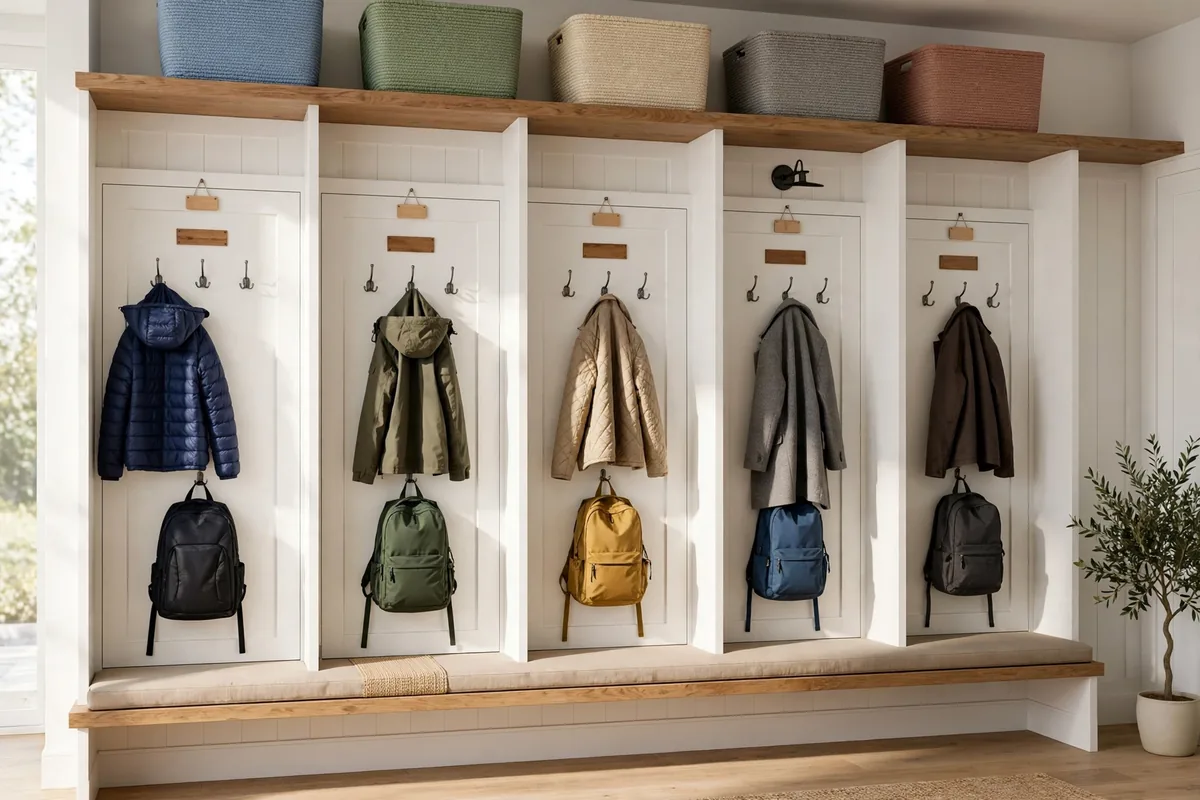
Nothing kills clutter faster than assigned territory. Give each person their own locker or cubby with their name on it — printed labels for adults, photos or color-coded baskets for pre-readers. One section per member holds their coat, bag and shoes, and the boundary makes it obvious when something is out of place. Even young children learn the system quickly when their zone is the same size and color every day.
2. Install a Storage Bench With a Lift-Up Seat
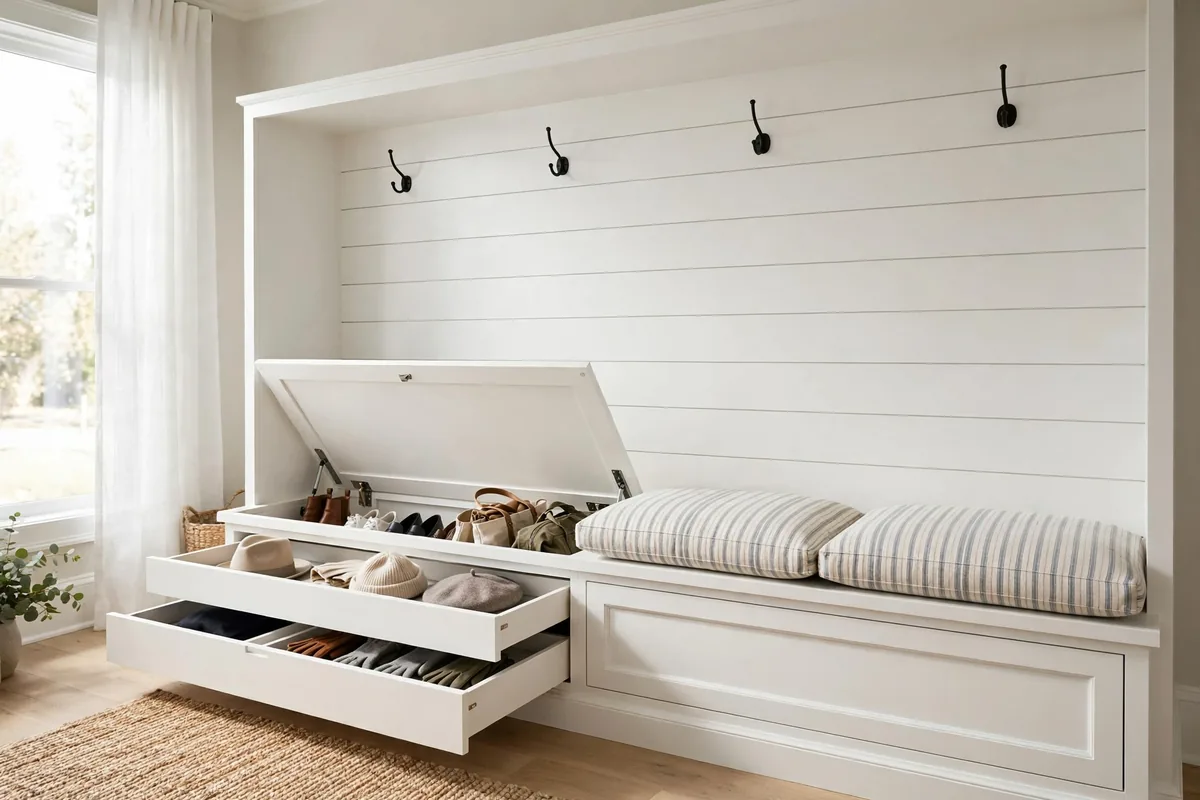
A bench gives everyone a place to sit while pulling boots on, and a lift-up seat or pullout drawers underneath turn that footprint into hidden storage for off-season shoes, reusable bags or pet leashes. Drawers beat lift-up lids for daily use because kids can access them without moving cushions. For more seating-and-storage combinations, see our collection of mudroom bench ideas — the right bench quietly doubles your storage without looking bulky.
3. Hang Double Rows of Hooks at Kid and Adult Heights
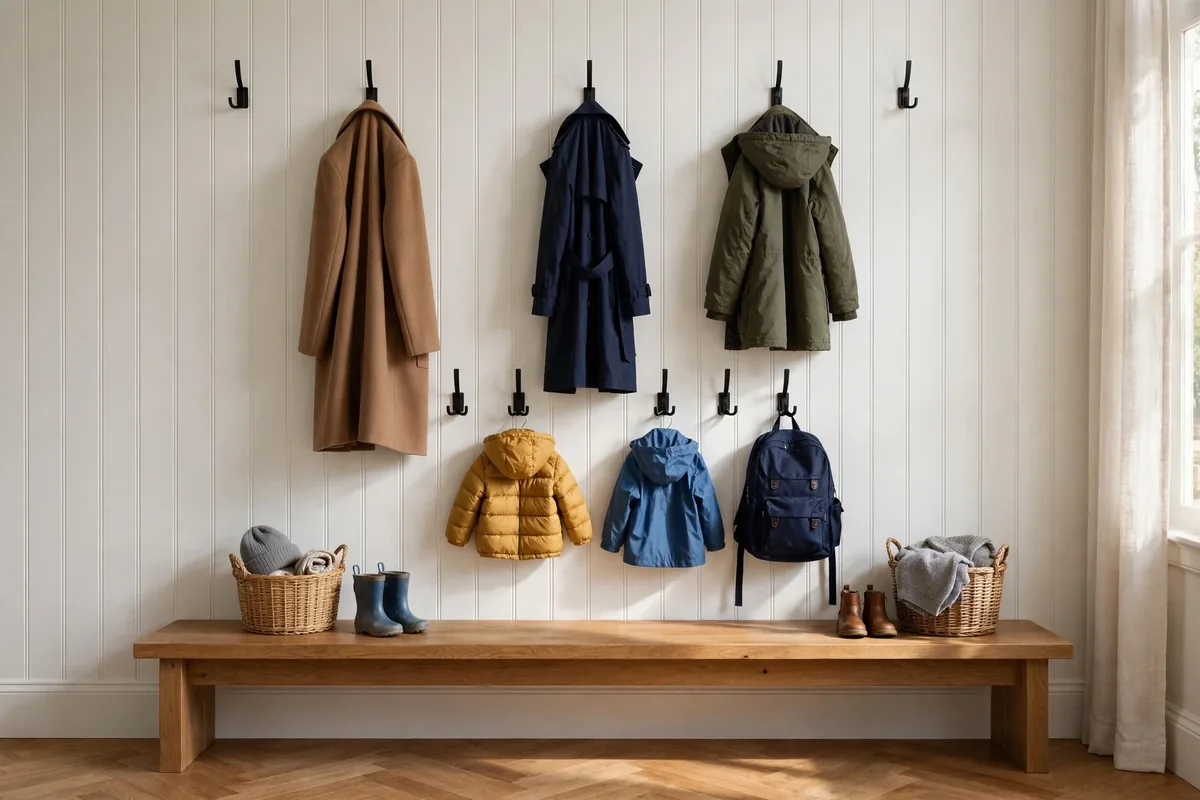
Hooks beat hangers for speed: one flick and the coat is up. Mount a row of sturdy hooks at adult height (around 60 inches) and a second row at 36 to 40 inches so children can hang their own things — ownership starts when kids can reach their spot. Use double hooks so a backpack and jacket share one station, and choose wide, rounded profiles; thin wire hooks bend under heavy winter coats and are the number-one reason hook systems fail.
4. Place a Washable Boot Tray by the Door
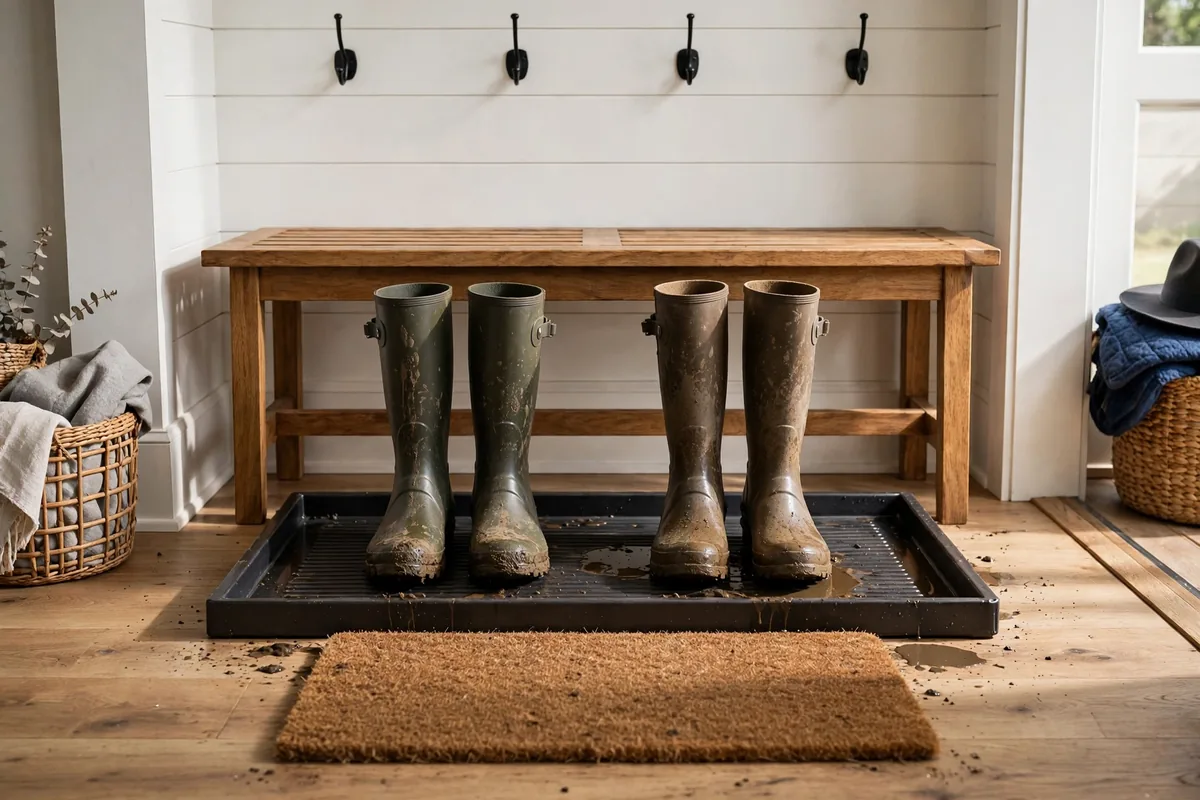
Muddy boots are the main reason mudrooms exist, and a boot tray confines the mess to one washable square. Choose a tray with a raised lip and a ribbed base so water drains away from soles instead of pooling. In winter, line it with a super-absorbent microfiber mat you can toss in the washing machine. Size it to your household — a family of five needs at least 36 inches of tray, or individual small trays per person.
5. Build a Shoe Cubby Wall With One Slot per Person
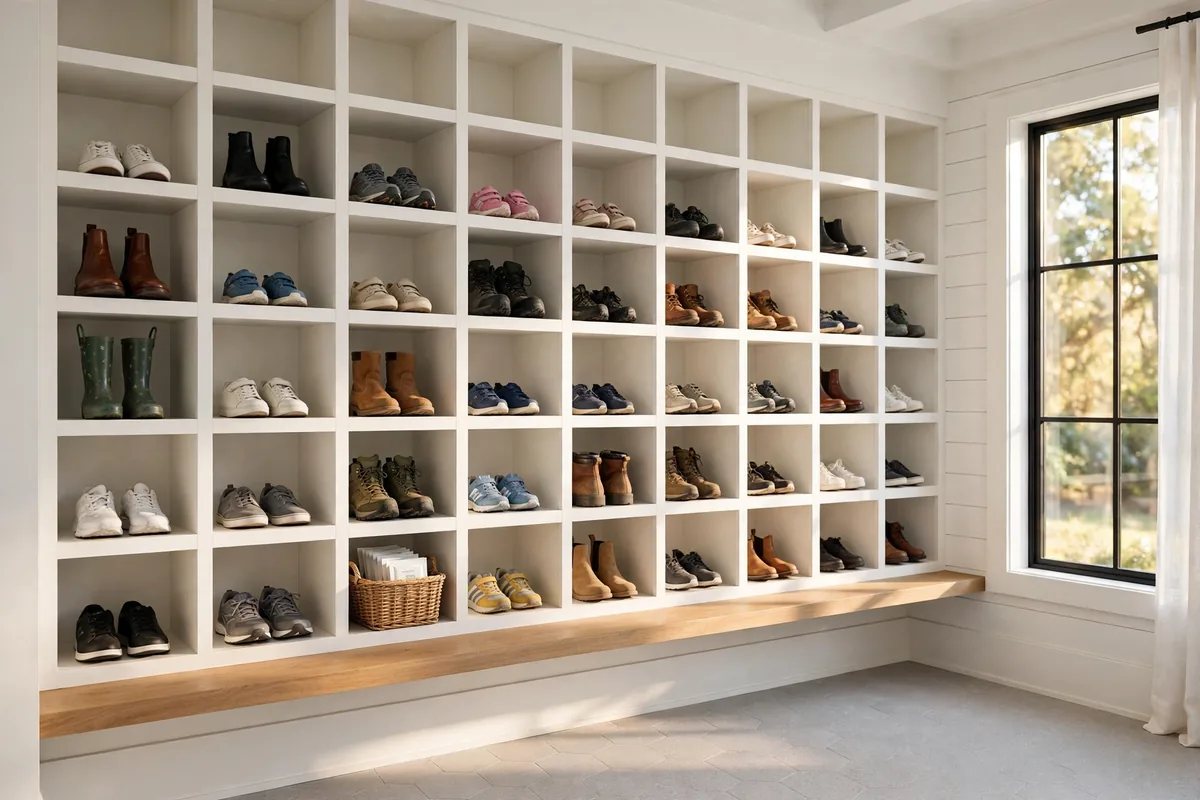
Shoes are the hardest category to tame because the volume never stops. Assign every family member one generous cubby slot for their daily pair, plus two or three shared overflow slots for guests and muddy backups. Whatever does not fit must move to a closet — the physical limit is the rule, and it prevents the slow drift back to floor piles. Stack cubbies floor-to-ceiling beside the bench to use vertical space.
6. Set Up a Grab-and-Go Basket Station
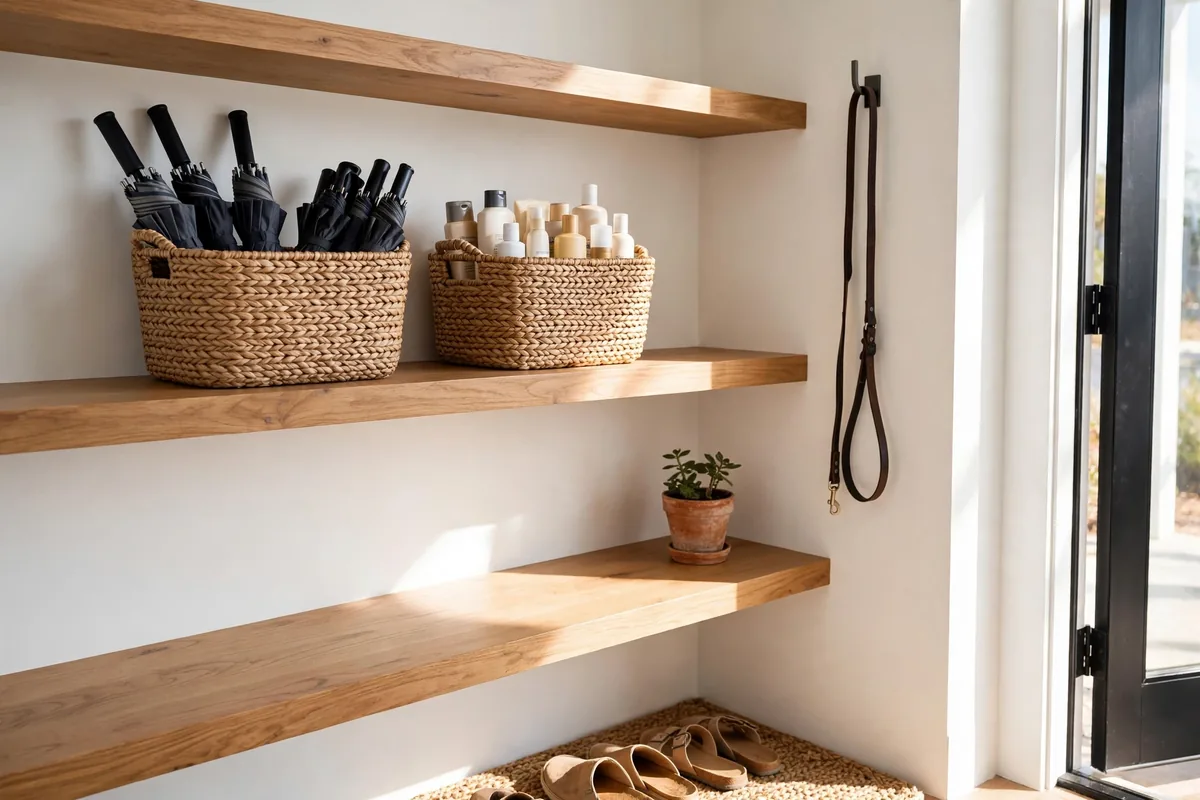
Some items never truly have a drawer: sunscreen, bug spray, dog treats, reusable bags, the umbrella. Corral them in open woven baskets on a shelf near the door, grouped by purpose — one “out the door” basket, one “pet” basket, one “sun/rain” basket. Open baskets matter because closed containers hide things and nobody opens them on the way out. Refresh the contents seasonally; gloves in January should become swim goggles in June.
7. Add a Family Command Center With Mail Sorter and Calendar
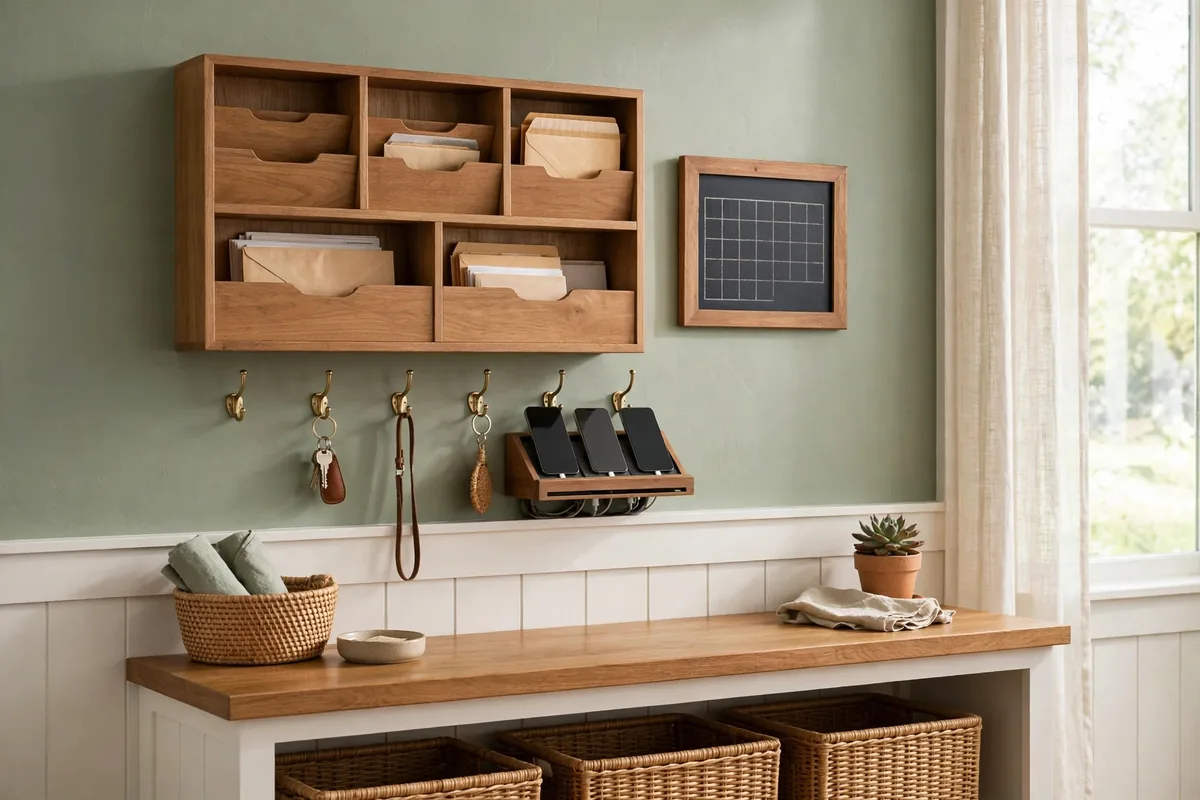
The mudroom is where you enter the house, so it is the natural spot for incoming paperwork. Mount a wall mail sorter with slots labeled “action,” “file” and “kids’ school,” plus a small whiteboard calendar beside it. Add a tray for chargers so devices land in one place. Processing mail the moment you walk in — recycling junk immediately — prevents the paper avalanche that eventually swallows every flat surface in the room.
8. Mount a Narrow Floating Shelf for Keys, Wallets and Sunglasses
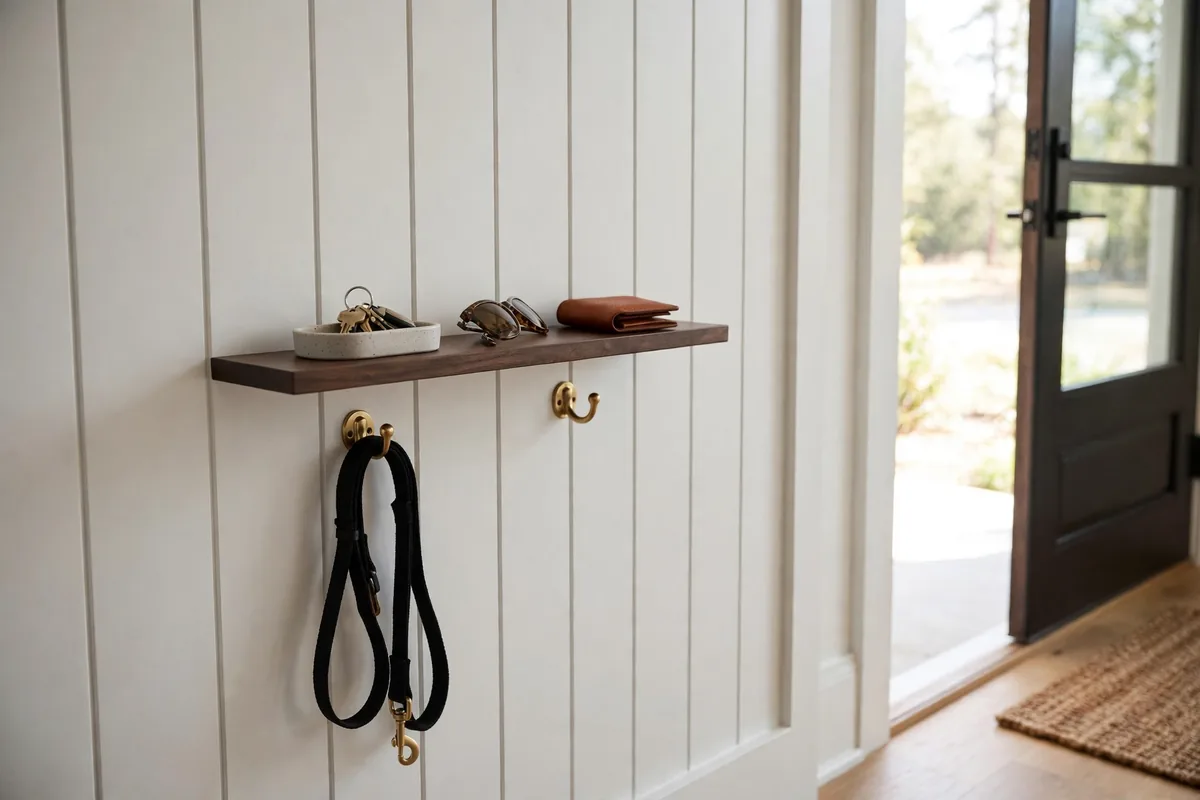
The tiny things cause the biggest delays. A slim floating shelf — just four to six inches deep — mounted at chest height by the door gives keys, wallets, sunglasses and earbuds a visible landing pad. Add a small tray on top so items do not slide off, and mount one tiny hook underneath for the dog leash. The rule that makes it work: nothing else lives on that shelf, so the 7 a.m. key hunt disappears permanently.
9. Use Closed Upper Cabinets for Seasonal and Overflow Gear
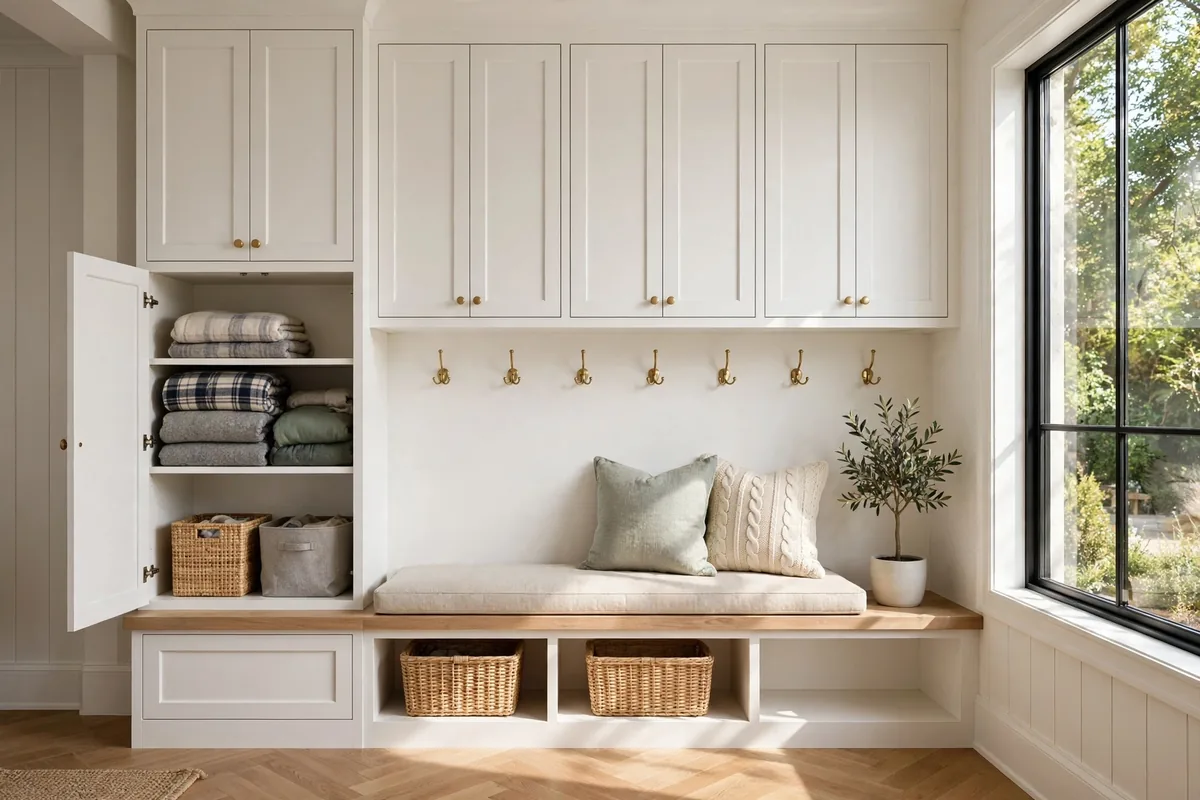
Open storage is fast but visually noisy, so balance it with closed upper cabinets above the hooks or bench. Store out-of-season items up there: winter parkas in summer, beach bags in winter, plus cleaning supplies and a bin of spare mittens. Because cabinets hide visual clutter, the room reads as calm even when it is full. Choose cabinets that reach the ceiling to avoid a dust-catching gap, and keep a small step stool nearby.
10. Create a Sports-Gear Zone With Vertical Racks
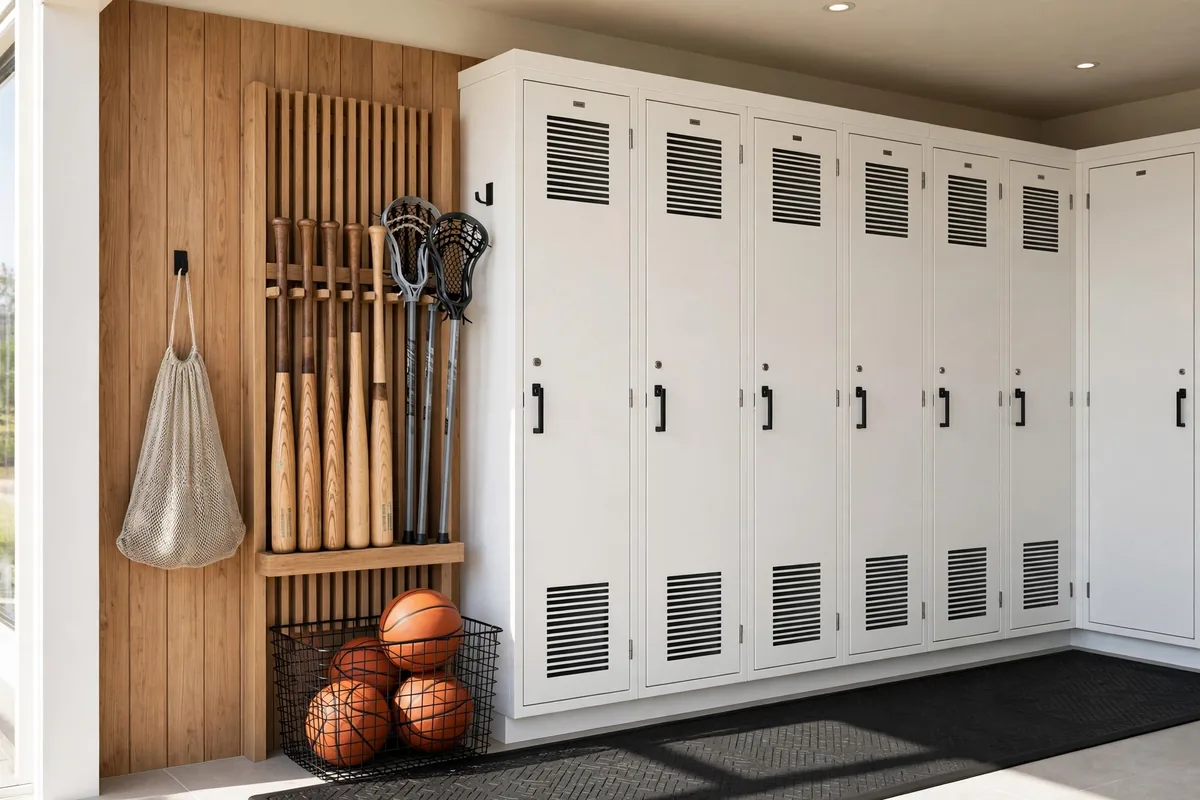
Bats, sticks, racquets and skateboards are the bullies of the mudroom — they fall over and take everything with them. Tame them with a vertical rack or a row of rubber broom grippers mounted inside a locker or on a narrow wall section. Each gripper holds one item upright, so nothing leans and nothing topples. Add a mesh bag on a hook for sweaty practice clothes and a small bin for balls.
11. Add a Pegboard Panel for Small-Item Flexibility
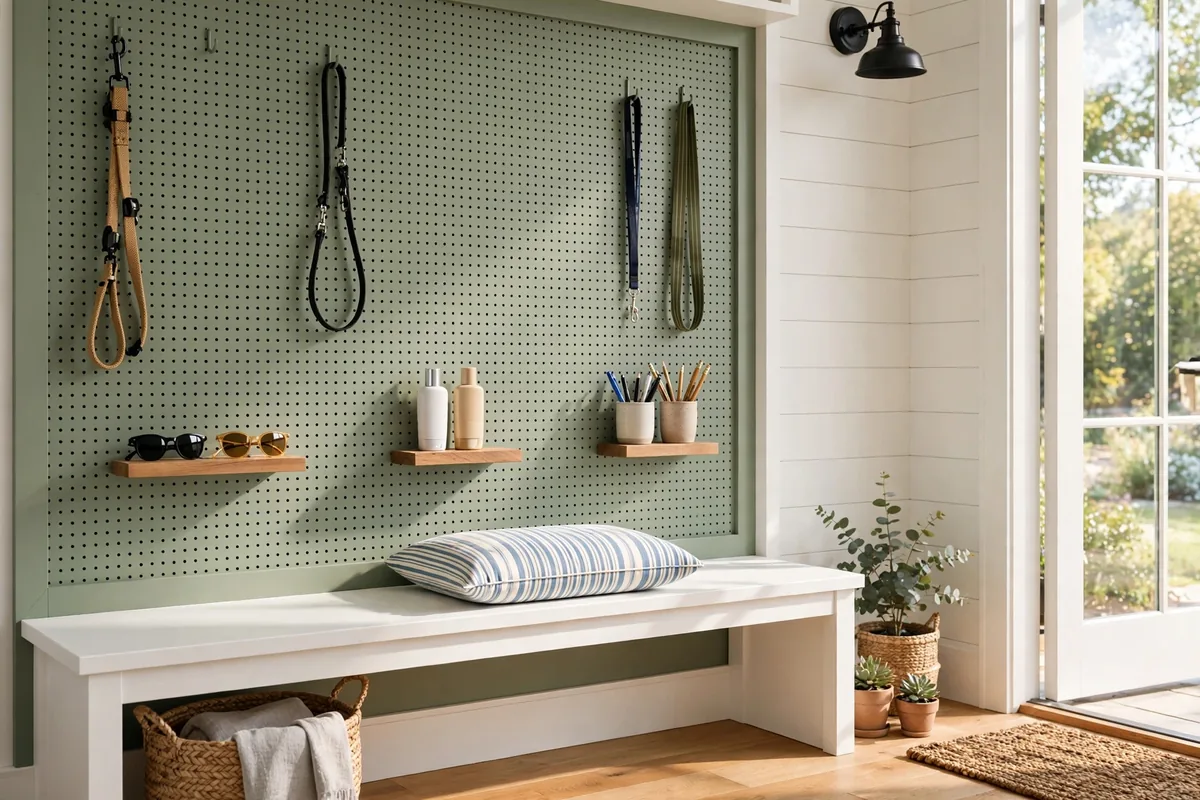
A pegboard turns a blank wall into infinitely adjustable storage for the small stuff: hooks for leashes and lanyards, small shelves for sunglasses, cups for pens and sunscreen. The advantage over fixed hooks is that you can rearrange everything as seasons and kids’ activities change — no new holes in the wall. Paint the pegboard the same color as the wall for a built-in look, or in a contrasting accent color as a deliberate feature.
12. Use a Slim Hall Tree or Console in Tight Spaces
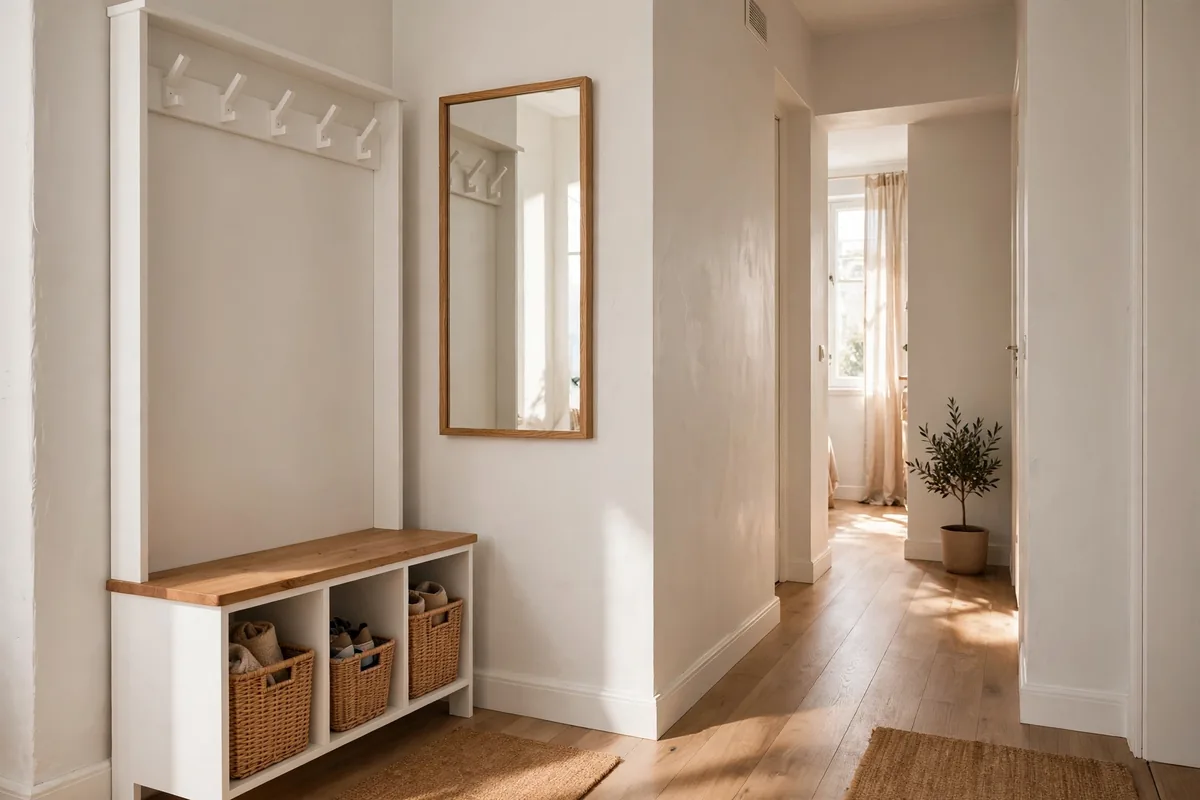
No dedicated mudroom? A narrow hall tree or slim console against the entryway wall creates a mini drop zone in as little as 12 inches of depth. Choose one that combines hooks, a small bench and shoe storage in a single vertical unit — stacking functions is the only way small spaces work. For plans and inspiration, Family Handyman’s roundup of entryway furniture ideas shows how to turn an empty wall into a hardworking entryway.
13. Lay Down a Durable Washable Runner
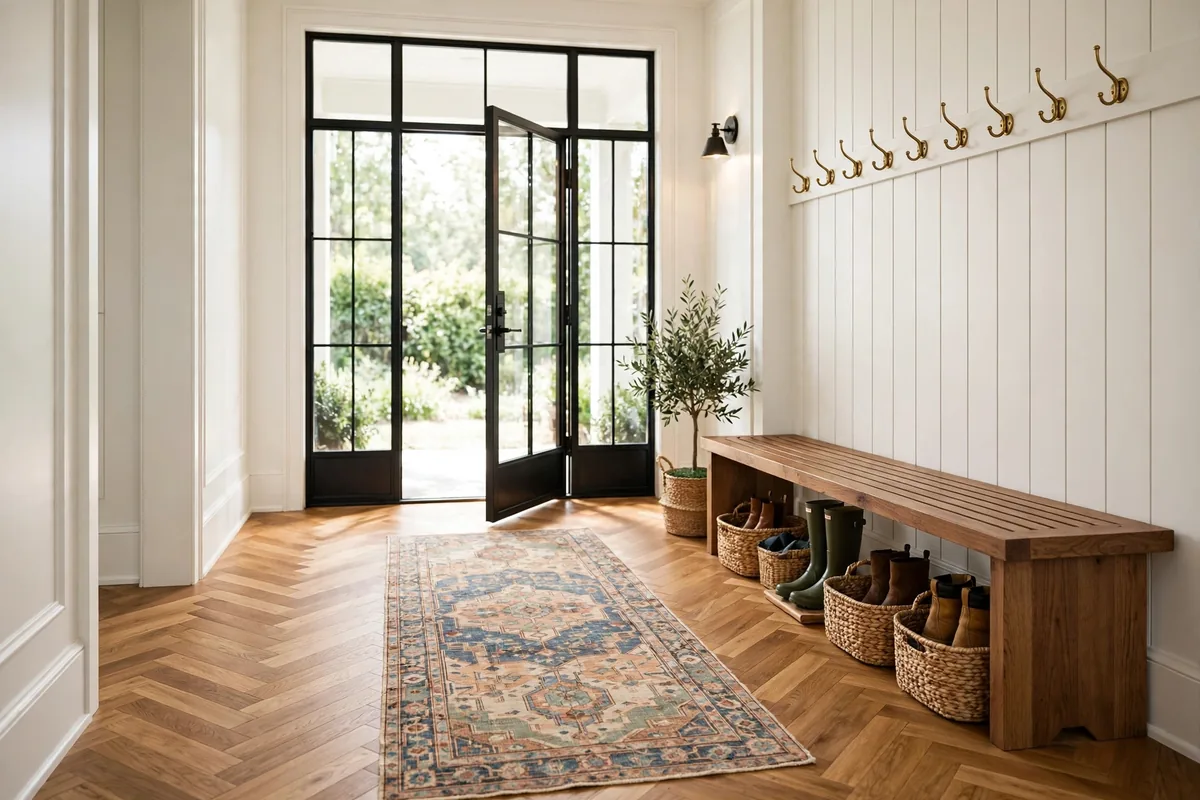
Floors take the beating in a mudroom, and a washable runner protects them while defining the traffic lane. Choose a low-pile, machine-washable rug in a dark or patterned weave that hides dirt between washes — jute-look synthetics and vintage-style printed rugs both perform well. The runner should span from the door to the bench so wet feet never touch bare floor. Shake it out weekly and machine-wash monthly.
14. Run a Five-Minute Nightly Reset
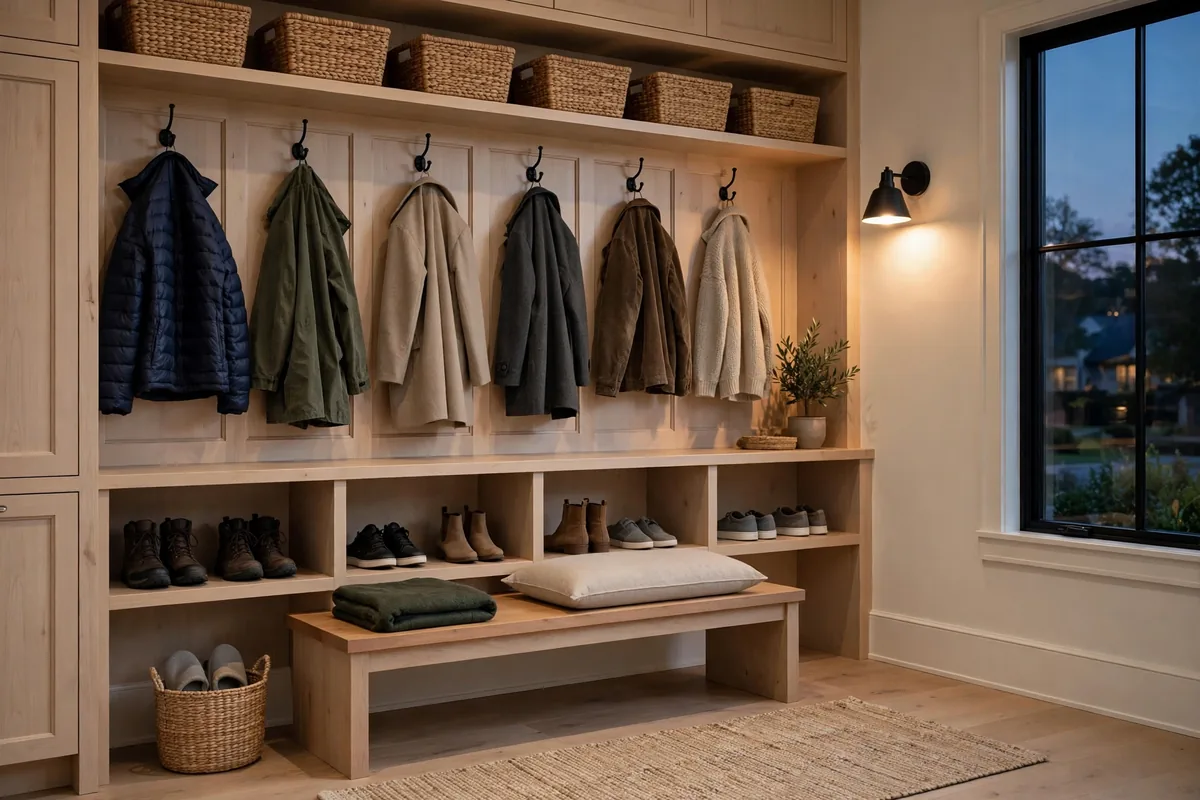
Even the best system drifts without maintenance, so build in a five-minute family reset before bedtime: everyone returns shoes to their cubby, hangs up their coat and empties the day’s debris from their basket. Set a phone timer and make it a race for the kids. Pair the nightly habit with a seasonal purge each quarter, donating outgrown coats and boots. Systems stay organized only when the reset is as automatic as locking the front door.
Frequently Asked Questions
How do I organize a mudroom for a large family?
Assign one labeled locker or cubby per person and enforce the boundary — when each member owns a zone, clutter has nowhere to hide. Scale shoe slots and hooks to headcount, not hope.
What is the best storage for a small mudroom?
Go vertical: staggered hooks, a slim hall tree, floating shelves and tall narrow cubbies. A storage bench gives seating plus hidden storage in one footprint.
How can I keep shoes from piling up in the mudroom?
Give each person one cubby slot for their daily pair and enforce a physical limit — overflow shoes move to a closet. A boot tray by the door catches muddy extras.
How do I organize kids’ gear in a mudroom?
Mount hooks at kid height (36–40 inches) and use color-coded or photo-labeled baskets. When children can reach and recognize their spot, they actually use it.
What should not be stored in a mudroom?
Avoid temperature-sensitive items like paint, aerosols or medications, keep valuables out of a space visitors pass through, and move off-season gear to closed cabinets so daily zones stay clear.
A mudroom that works is a mudroom with a system — assigned spots, physical limits and a five-minute reset. Start with two or three of these ideas this weekend, and your entryway will stop being the room everyone avoids and start being the one that keeps the whole house running.
